The Convergence of Competitive Strategy Gaming and Casino Mechanics: Psychological, Market, and Regulatory Dynamics
The Death of the “Pure Skill” Illusion
Let’s be real for a second about the state of digital play. For decades, the industry insisted that strategy games and gambling existed in entirely separate universes. You supposedly had the rigorous realms of chess or auto-battlers on one side, while the blind mathematical void of slot machines sat on the other. That invisible wall is completely shattered today. Look at the current player ecosystem, and a massive migration of high-tier competitive gamers toward slot reels becomes painfully obvious. This is not some spontaneous spike in reckless behavior. Pull back the curtain on this industry, and you will find a highly optimized neurological engine quietly powering both sectors.
We need to shatter a massive misconception right now. Nobody grinding at the top of an esports ladder treats a match like some random collection of physical inputs. High-level competitors process immediate tactical risks while bracing for long-term variance. Modern gambling ecosystems simply grab that exact cognitive load and crush it down into violent, high-speed micro-cycles. A mathematically wired gamer looks at a hyper-volatile slot machine and sees nothing but a raw, unsolved risk profile begging to be optimized. These are the exact analytical grinders who spend hours dissecting frame data in fighting games. Sharp players actively ignore neon promotional banners. They seek out independent, hardcore vetting platforms like Casinofy specifically because the team running that site burns their own actual cash to test the software. Grinders have absolutely zero time to dissect fifty pages of weaponized casino fine print. By leaning on a platform that verifies every single bonus term directly against operator rules, these analytical minds treat the casino floor exactly like an esports bracket.
Hijacking the Machine Zone: Neurobiology and the Near-Miss
The mechanical overlap makes perfect sense once you realize the brain chemistry is identical. Mega-corporations burn billions weaponizing the exact same physiological circuits. Forget all that trendy self-help garbage; dopamine triggers anticipation, not a reward. Your brain’s circuitry actually fires infinitely harder when an outcome is totally uncertain.
Psychologists figured this out over half a century ago using variable ratio reinforcement schedules. Give a lab rat a treat every third time it hits a button, and it eventually walks away bored. Dispense that same treat at total random, however, and the animal hits the switch until it collapses. Slots pay out on a mathematically unpredictable timeline to ensure your dopamine levels never get a chance to crash. Complex video games trigger this exact same response through randomized loot boxes, erratic human opponents, and unpredictable critical hit calculations.
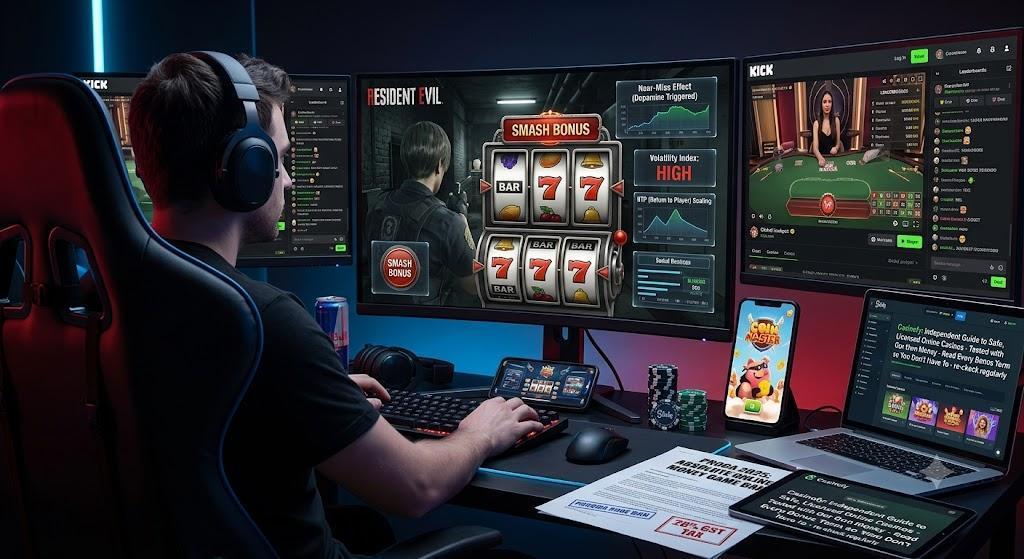
Then you have the near-miss effect, which is arguably the most sinister tool in a developer’s arsenal. Two jackpot symbols lock onto the payline perfectly, but the third drops just a fraction of an inch out of bounds. Logically, your cash is gone. Neurologically, your brain gets completely hijacked. That visual tease registers as genuine skill acquisition—even though a cold, hard RNG chip rigged the entire sequence. Grinders who play competitive ladders obsess over mastery. Consequently, that razor-thin loss kicks off a desperate instinct to recalibrate. Before they even realize what happened, a heavy trance sets in. They just get dragged straight down into the void of the machine zone.
When Slots Started Playing Like Arcades
Passive reels simply do not work on a younger demographic. Millennials and Gen Z grew up demanding intense, kinetic interactivity. To survive this demographic shift, the casino industry had to tear down and rebuild its software architecture entirely. Developers stopped slapping video game textures on random number generators and started building actual hybrid skill-based machines.
You can walk onto a casino floor right now, grab an arcade joystick, and blast zombies on a screen to multiply your payout. The structural catch here is brilliant. The base spins are entirely RNG, yet triggering a bonus round suddenly ties your financial outcome directly to physical dexterity. Flawless mechanical play unlocks the machine’s maximum theoretical return. Sloppy aim guarantees the house takes a massive cut. Two distinct people can wager the exact same dollar amount and walk away with wildly different bankrolls based solely on controller execution.
Social casino giants took a different route. Moon Active ignored traditional Vegas aesthetics entirely with Coin Master, opting for a cartoon pig and a Viking village-building loop. The app hands you a finite number of slot spins to generate capital, which you immediately dump into upgrading buildings. But your accumulated wealth is completely exposed. Friends can raid your base while you sleep, utilizing vicious multipliers to wipe out your progress in minutes. This creates a crippling sense of loss aversion. Players feel immense psychological pressure to buy extra spins just to finish a village before logging off for the night.
Broadcast Wagering and the Exile to Kick
The platform wars poured gasoline all over this convergence. Amazon held an absolute monopoly on broadcasting for ages through Twitch. Then a highly toxic subculture of crypto-punters completely hijacked the algorithm. You had twenty-somethings blasting seven-figure crypto wallets live to an audience of impressionable teenagers. The resulting PR nightmare finally forced Amazon executives to pull the plug in late 2022. They completely blacklisted unregulated juggernauts like Stake.com.
But let’s be realistic: billions in gray-market revenue never just evaporates. It simply migrates to a different server. Just months after the ban, Kick.com went live. The exact same billionaires who founded Stake heavily subsidized this new platform. They lured in esports titans and massive influencers with an absurd 95/5 revenue split and contracts reportedly worth up to $100 million. Top-tier streamers are not surviving on small viewer subscriptions anymore. They receive millions to gamble on stream, taking a massive cut of a player’s lifetime losses the second a viewer uses their affiliate code. The entire broadcasting site functions as a giant loss-leader designed to funnel gaming audiences straight into unregulated crypto casinos.
The Regulatory Gridlock and the Free-to-Play Trojan Horse
Governments across the globe are completely paralyzed by this hybrid reality. Legal frameworks drafted decades ago cannot compute digital environments where the line between skill and chance no longer exists. Lawmakers from European parliaments to North American statehouses are currently watching their traditional gambling definitions disintegrate in real-time. You have jurisdictions frantically trying to classify a loot box or a social village-builder as an unlicensed betting product, only to get bogged down in years of appellate court battles. When international regulators finally panic, they usually swing massive legislative sledgehammers at the basic concept of a wager. Some nations impose draconian blanket bans on any digital action involving real money, while others slap catastrophic taxes on gross gaming revenue to bleed operators dry.
Corporate boardrooms simply do not care about these clumsy legal maneuvers. They instantly shove their massive player bases toward casual puzzles or freemium base-builders to dodge the crosshairs. Sure, developers rip out the direct fiat deposits. Yet the vicious, highly engineered compulsion loops survive completely untouched. Savvy studios just sidestep the blow entirely. They quietly stuff a fully functional casino floor into a casual mobile app—bypassing the wager completely. The house frankly does not give a damn about outdated legal gambling definitions anymore; they just monetize your physiological compulsions directly.