Minecraft Dirt Block Guy: Everything You Need to Know About Steve in 2026
If you’ve spent any time in the Minecraft community, or gaming culture at large, you’ve probably heard someone reference the “dirt block guy.” That blocky, bearded figure holding a cube of dirt has become one of gaming’s most recognizable icons, even though having no official backstory, no dialogue, and a design that looks like it was rendered on a calculator from 1995. Yet Steve, the default Minecraft player character, has transcended his humble polygonal origins to become a cultural phenomenon that’s spawned countless memes, merchandise, and even a spot on the Super Smash Bros. roster.
But who exactly is Steve? Why does he carry that dirt block everywhere? And how has a character with literally zero personality become one of the most beloved figures in gaming? Whether you’re a veteran miner or just curious about why this pixelated guy keeps popping up in your feed, this guide breaks down everything from Steve’s design origins to advanced gameplay strategies, his evolution across Minecraft’s patches, and his surprising impact beyond the game itself.
Key Takeaways
- Steve, the default Minecraft dirt block guy, became a global gaming icon despite having no voice lines, backstory, or complex character design, proving that simplicity and player projection matter more than narrative depth.
- The dirt block represents Minecraft’s core gameplay loop—the fundamental resource that symbolizes gathering, building, and surviving from the very first moments of the game.
- Steve’s mechanics evolved significantly throughout Minecraft’s history, from basic Alpha animations to advanced features like sprinting, hunger systems, and combat refinements that deepen gameplay strategy.
- Steve’s inclusion as a fighter in Super Smash Bros. Ultimate marked gaming’s ultimate seal of iconic status, introducing unprecedented crafting mechanics that balanced resource management with competitive combat.
- The Minecraft community shaped Steve’s identity through countless memes, fan art, and creative content, filling in personality gaps and creating deeper attachment than any corporate marketing could achieve.
- Steve remains relevant across gaming culture through extensive merchandise, pop culture references, and continuous integration into new Minecraft versions as the constant symbol of boundless creative possibility.
Who Is the Minecraft Dirt Block Guy?
The Origin of Steve’s Iconic Design
Steve wasn’t always called Steve. When Minecraft creator Markus “Notch” Persson first designed the default player character during the game’s early development in 2009, the character had no official name. The blocky humanoid with a blue shirt, dark pants, and a neatly trimmed beard was simply “the player.” The name Steve emerged organically from the community and was eventually acknowledged by Notch himself in interviews, though it wasn’t officially confirmed by Mojang until years later.
The design philosophy behind Steve was brutally simple: create a human character using the game’s existing block-based aesthetic with minimal detail. Each body part is a rectangular prism, and the 8×8 pixel face gives just enough definition to suggest eyes, a nose, mouth, and facial hair. This wasn’t laziness, it was consistency. Steve’s design perfectly matches Minecraft’s core visual language where everything, from terrain to creatures, adheres to blocky geometry.
Why Players Call Him the “Dirt Block Guy”
The “dirt block guy” nickname stems from Minecraft’s promotional artwork and the game’s main menu screen, where Steve is frequently depicted holding a dirt block. This became the character’s de facto signature pose, appearing in countless promotional images, merchandise, and even the game’s app icon on various platforms.
Why a dirt block specifically? It’s the most fundamental resource in Minecraft. Dirt is abundant, easy to gather, and represents the starting point of every player’s journey. That humble brown cube symbolizes the game’s core loop: punch blocks, gather resources, build things, survive. The association became so strong that when players think of Minecraft’s visual identity, they picture Steve with that dirt block. It’s not a diamond pickaxe or an enchanted sword, it’s the simplest block in the game, and that’s precisely the point.
Steve’s Role in Minecraft Gameplay
Default Player Character and Customization Options
Steve serves as the default player character for Minecraft: Java Edition and Bedrock Edition across all platforms (PC, PlayStation 5, Xbox Series X
|
S, Nintendo Switch, iOS, and Android). When players start a new world without selecting a custom skin, they spawn as Steve. Since the 1.8 Combat Update and subsequent versions, players have been able to customize their appearance through skins, either by selecting from pre-made options or uploading custom designs.
As of 2026, Minecraft version 1.21.x offers extensive character customization through the Character Creator feature in Bedrock Edition, allowing players to modify body type, clothing, accessories, and more while maintaining the classic blocky proportions. Java Edition players continue to use traditional skin files, with thousands available through community sites and modding platforms like Nexus Mods that host custom texture packs and character designs.
Steve’s Abilities and Limitations
Steve (and any player character in Minecraft) has consistent baseline abilities regardless of skin choice:
- Health: 20 HP (10 hearts)
- Hunger: 20 food points (10 drumsticks)
- Inventory: 36 general slots plus 4 armor slots and an off-hand slot
- Reach distance: 4.5 blocks in Survival mode
- Movement speed: 4.317 m/s walking, 5.612 m/s sprinting
Steve’s limitations are what define Minecraft’s survival challenge. He can’t naturally regenerate health without food (when hunger is above 18 points), drowns after 15 seconds underwater without air, and takes fall damage from drops exceeding 3 blocks. These constraints force strategic thinking around resource management, shelter construction, and equipment crafting, the core gameplay loop that’s kept Minecraft relevant for over a decade.
The Evolution of Steve Throughout Minecraft’s History
From Alpha to Modern Updates
Steve’s visual appearance has remained remarkably consistent since Minecraft Alpha (2010), but the character’s technical implementation has evolved significantly. In the early Alpha and Beta versions, the player model was extremely basic with limited animation. Arms swung mechanically, there was no head bobbing, and crouching didn’t exist.
The Adventure Update (Beta 1.8) in 2011 introduced sprinting and hunger mechanics, fundamentally changing how players interacted with Steve’s physical abilities. The 1.0 full release added enchanting and brewing, expanding what Steve could accomplish. The 1.8 Combat Update (2014) overhauled melee mechanics, attack cooldowns, and dual-wielding, giving Steve’s combat capabilities more depth.
More recently, the 1.19 Wild Update (2022) and 1.20 Trails & Tales (2023) have refined animation smoothness and added new interaction animations. The upcoming features teased for late 2026 suggest further polish to player model rigging, though Steve’s core design remains untouched, a testament to its timeless simplicity.
Steve vs. Alex: The Addition of Character Diversity
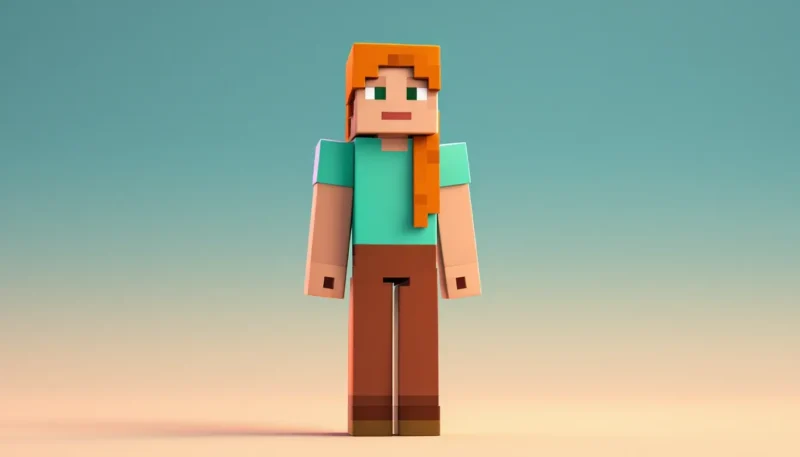
In September 2014, Mojang introduced Alex as an alternative default character model with the 1.8 update. While Steve has a broader build with 4-pixel-wide arms, Alex features a slimmer model with 3-pixel-wide arms, providing more character variety without fragmenting the game’s aesthetic.
The addition wasn’t about replacing Steve but expanding representation. Players could now choose between two default models when designing custom skins, and Mojang began featuring both characters equally in promotional materials. This move acknowledged that Minecraft’s player base was diverse and shouldn’t be represented by a single default character.
As of 2026, both Steve and Alex remain equally prominent, and the Character Creator in Bedrock Edition allows mixing elements from both base models. Even though this, Steve maintains cultural primacy as the original, he’s still the face on most merchandise and the character that appears in crossover content.
Steve’s Impact on Gaming Culture and Memes
Viral Memes and Internet Fame
Steve’s deliberately crude design made him perfect meme material. The “realistic Minecraft Steve” memes that depict the character with exaggerated muscular proportions and hyper-detailed textures became a viral sensation across Reddit, Twitter, and TikTok throughout the late 2010s and early 2020s. These absurdist interpretations play on the contrast between Steve’s blocky simplicity and realistic rendering techniques.
The “Minecraft walking animation” became another meme vector, with creators applying Steve’s stiff arm-swinging walk cycle to real-world footage and other game characters. His complete lack of facial expression, those unchanging 8×8 pixels, somehow made him more relatable, a blank canvas for whatever emotion or situation meme creators needed.
Community sites have chronicled Steve’s meme evolution extensively, with dedicated gaming guides on platforms like Twinfinite documenting his various internet incarnations. The character’s memetic success stems from that same design philosophy that made Minecraft successful: simplicity that invites creative interpretation.
Steve in Super Smash Bros. Ultimate
Steve’s inclusion in Super Smash Bros. Ultimate (October 2020) as DLC Fighter #77 was one of the most significant crossover events in gaming history. Director Masahiro Sakurai called implementing Steve “extremely difficult” due to the character’s unique mechanics requiring fundamental changes to how stages function.
Steve’s moveset perfectly translates Minecraft’s core gameplay into a fighting game context:
- Neutral Special: Mine blocks from the stage to gather resources
- Side Special: Place blocks to create platforms and walls
- Up Special: Use an Elytra for vertical recovery
- Down Special: Place TNT, pressure plates, and other utility blocks
- Crafting mechanic: Use gathered materials to upgrade tools (wood → stone → iron → diamond)
The crafting system was unprecedented in Smash Bros., requiring Steve players to balance resource management with combat, essentially playing Minecraft while fighting. This mechanical depth made Steve immediately viable in competitive play, with players like Acola achieving major tournament wins using the character throughout 2023-2025.
Steve’s inclusion validated Minecraft’s cultural impact. Getting into Smash Bros. is gaming’s ultimate seal of iconic status, and Steve earned that spot not through narrative depth or complex characterization, but through representing one of the most influential games ever created.
How to Get the Most Out of Playing as Steve
Essential Survival Tips for Beginners
Playing as Steve effectively means mastering Minecraft’s survival fundamentals. Here’s how to make the most of those first critical minutes:
First Day Priority List:
- Punch 10-15 wood blocks from trees immediately (craft a crafting table and wooden pickaxe)
- Gather 20+ cobblestone before sunset using your wooden pickaxe
- Craft a stone pickaxe, stone axe, and stone sword (stone tools mine 2x faster than wood)
- Build a basic shelter before nightfall, even a dirt box with a door works
- Create a bed if you find sheep (3 wool + 3 planks): sleeping resets spawn point
Resource Management:
- Keep your hunger above 18 points for health regeneration
- Always carry a water bucket (negates fall damage, extinguishes fire)
- Never dig straight down (you’ll fall into lava or caves)
- Mark your base coordinates using F3 on Java Edition or by crafting a map
Combat Basics (1.21.x):
- Swords have a 0.6-second attack cooldown, wait for the indicator to refill
- Critical hits (jumping + attacking) deal 50% extra damage
- Shield blocking (right-click/L2/LT) negates 100% of frontal damage
Mastering these basics transforms Steve from a vulnerable newcomer into a capable survivor within a few in-game days.
Advanced Building Techniques with Basic Blocks
Steve holding that dirt block isn’t just symbolic, basic blocks are the foundation of advanced building. Here’s how experienced players maximize common materials:
Dirt and Grass Block Applications:
- Temporary scaffolding: Dirt is abundant and mines instantly with a shovel, making it perfect for building pillars and temporary structures you’ll dismantle later
- Blast protection: Dirt has an explosion resistance of 0.5, but placed in multiple layers, it effectively absorbs creeper blasts protecting valuable builds
- Mob-proof gardens: Grass blocks allow crop growth and animal spawning without being classified as “natural” spawn spaces for hostile mobs when properly lit
Cobblestone Efficiency:
- Cobblestone generates infinitely from lava + water sources: build a cobblestone generator for unlimited building material
- Its 6.0 explosion resistance makes it ideal for blast-resistant bases
- Craft into stairs and slabs for architectural detail without sacrificing durability
Block Palette Theory:
Advanced builders use basic blocks as the foundation of complex palettes. Combine stone variants (cobblestone, stone bricks, andesite) with wood accents and greenery for sophisticated builds. The key is texture variation within a limited color scheme, exactly what Steve’s simple design exemplifies.
Best Skins and Customization Ideas
While Steve’s classic look is iconic, customization keeps the character fresh. As of 2026, players have access to thousands of skins through the Minecraft Marketplace (Bedrock Edition) and community sites (Java Edition).
Popular Skin Categories:
- Classic variants: Miner Steve, Adventurer Steve, Tuxedo Steve
- Mashups: Steve crossed with other gaming characters (Doom Steve, Zelda-style Steve)
- Seasonal: Holiday-themed variations
- Meme skins: Based on viral Steve memes and internet culture
Creating Custom Steve Variants:
For Java Edition, use skin editors like Skindex or Miners Need Cool Shoes to modify Steve’s default texture:
- Download Steve’s base skin file
- Edit in any image editor supporting transparent PNGs
- Keep the classic silhouette but modify colors, add accessories, or change clothing
- Upload to your Minecraft profile
Custom skins can be found through community resources, with detailed character builds and guides available on Game8 covering everything from color theory to advanced texture techniques. The best custom Steve skins maintain the character’s recognizable shape while adding personal flair, honoring the original while making it your own.
Steve’s Appearances Beyond Minecraft
Merchandise and Pop Culture References
Steve’s merchandising presence is massive. Walk into any gaming retail space and you’ll find:
- Action figures and collectibles: LEGO Minecraft sets featuring Steve (with interchangeable tools and blocks), Funko Pop figures, and detailed figurines from manufacturers like Mattel and Jazwares
- Apparel: T-shirts, hoodies, and hats bearing Steve’s pixelated face are ubiquitous at conventions and retail chains
- Accessories: Backpacks, lunchboxes, phone cases, and even Steve-themed headphones
- Home goods: Bedding, posters, night lights, and room décor
Steve has appeared in unexpected places outside gaming retail. He’s been referenced in TV shows like South Park and The Simpsons, appeared in YouTube Rewind videos (back when those existed), and shown up in countless parody videos across streaming platforms. His visual simplicity makes him instantly recognizable even in brief cameos or stylized interpretations.
The character’s merchandising success rivals established gaming icons like Mario or Sonic, remarkable for a character who’s essentially a blank avatar with no canonical personality or story.
Fan Art and Community Creations
The Minecraft community has produced an staggering volume of Steve-related content. DeviantArt, ArtStation, and Twitter host thousands of interpretations ranging from faithful pixel art recreations to realistic paintings and 3D renders.
Popular Fan Creation Categories:
- Realistic renders: High-fidelity 3D models of Steve in various scenarios, often exploring what he’d look like with realistic proportions, textures, and lighting
- Animated content: YouTube channels like Element Animation and others have built entire series around Steve and Alex’s adventures
- Comics and manga: Fan-created stories giving Steve personality, backstory, and narrative arcs Mojang never provided
- Music videos: Original songs and parodies featuring Steve, including multi-million view hits like “Revenge” (a Minecraft parody of Usher’s “DJ Got Us Fallin’ In Love”)
The community’s creativity has essentially built Steve’s character from scratch. Mojang provided the canvas, a blocky guy with no backstory, and millions of players filled in the gaps with their own interpretations. That collaborative character-building is unprecedented in gaming.
Why Steve Remains an Iconic Gaming Character
Steve’s enduring iconic status seems paradoxical. He has no voice lines, no canonical backstory, no character arc, and a design that could charitably be called “minimalist.” Yet he’s instantly recognizable to gamers and non-gamers alike, rivaling characters with decades of narrative development and marketing behind them.
The secret is that Steve represents something bigger than himself. He’s not a character you watch, he’s an avatar you become. Every player’s first experiences with Minecraft happen through Steve. He’s been present for millions of players’ first shelter, first mine, first Nether portal, and first dragon kill. Those experiences shape Steve’s identity more than any pre-written story could.
His visual design supports this role perfectly. The lack of detail invites projection rather than forcing identification. Players see Steve not as a specific personality but as a vessel for their own creativity and adventures. His blocky appearance matches Minecraft’s core philosophy that simple elements combined with player creativity produce extraordinary results.
Minecraft’s continued dominance ensures Steve’s relevance. As of early 2026, Minecraft remains the best-selling video game of all time with over 300 million copies sold across all platforms. Each new player starts their journey as Steve, perpetuating his status with every new generation of gamers.
He’s also benefited from Mojang and Microsoft’s relatively hands-off approach. By not forcing a canonical characterization, they’ve allowed the community to shape Steve organically through memes, art, and shared experiences. That collaborative ownership creates deeper attachment than any corporate marketing campaign could achieve.
Steve’s inclusion in Super Smash Bros. Ultimate cemented his status among gaming’s absolute elite, the characters whose cultural impact transcends their origin games. He stands alongside Mario, Link, Pikachu, and Pac-Man not because of complex character design, but because he represents one of gaming’s most influential and creatively empowering experiences.
Conclusion
The “dirt block guy” has come a long way from his humble origins as a hastily designed player avatar in an indie game’s alpha build. Steve’s journey from nameless placeholder to global gaming icon demonstrates that character design isn’t about polygons or backstory, it’s about the experiences players associate with that character and the creative space they’re given to make it their own.
Whether you’re spawning into your first world, perfecting advanced redstone contraptions, or competitively battling in Smash Bros., Steve remains the constant, that blocky figure holding a simple dirt block, ready for whatever adventure comes next. In 2026 and beyond, as Minecraft continues evolving and reaching new players, Steve will be there at the start of every journey, silent and simple as ever, representing the boundless possibility of a world made of blocks.