
RNG vs. Skill: Why Roguelike Deckbuilders Are Taking Over
The House Always Wins (Until You Hack the Deck)
Let’s be real. The video game industry did not plan for a spreadsheet simulator disguised as a card game to completely dominate the 2026 fiscal year. Slay the Spire 2 dropped in early March and immediately pulled over half a million concurrent players on Steam. That is not a niche subculture. This represents a permanent market shift. Studios used to bet hundreds of millions on motion-capped RPGs to secure those kinds of numbers. Now, solitary developers are bankrupting AAA launch weeks with 2D math puzzles. Look closer at Balatro’s massive 2024 run—generating upwards of $40 million—and the reality becomes brutally clear. The frictionless onboarding of poker hands proved that players are exhausted by cinematic bloat. Audiences prefer to domesticate chaos instead.
We Hate Losing to Dice, We Love Losing to Math
A missed shotgun blast at point-blank range in X-COM feels like a personal insult. Industry veterans label this exact mechanic “output randomness”—and let’s be honest, it drives audiences up the wall. The random number generator intercepts a perfect tactical plan and flat-out tells the player they failed. The result is a severed feedback loop. Optimal decisions stop guaranteeing optimal results, which trains players to feel a profound lack of agency.
Roguelike deckbuilders flipped this paradigm entirely by stealing a psychological trick called input randomness. You spawn into a boss fight, the engine shuffles your deck, and the enemy broadcasts a lethal 45-damage strike. Every variable on the board locks into place before your hand even reaches the mouse. A card promising a clean dozen points of damage will deliver exactly that amount, every single time. Your job is simply to untangle a perfectly deterministic puzzle born from a chaotic seed. When you inevitably die because you could not block the hit, the failure does not belong to a bad dice roll. The fault traces directly back to a strategic error you made in the macro-game. Perhaps you diluted your deck with too many disparate synergy pieces. The genre preserves human agency while constantly shifting the ground beneath your feet.
Counting Cards Without the Pit Boss
This architectural philosophy is just casino risk-assessment stripped of the velvet ropes and exorbitant drink prices. The thrill of a deckbuilder comes directly from exploiting probability. Players used to count traditional blackjack card values to see if the dealer was mathematically doomed long before anyone cared about vulnerability multipliers on a digital dragon. Today’s procedural games simply weaponize that foundational arithmetic.
A dealer stuck showing a 5 or 6 usually faces disaster, mostly because a massive chunk of the shoe holds 10-value cards. The casino itself absorbs all the nasty variance in that scenario. Modern titles like Breach Wanderers rely on this exact logic for digital combat. They explicitly broadcast the enemy’s “intent” right above their avatar—the ultimate upcard. The game state transforms from a reactive struggle into a proactive calculation. Furthermore, the concept of splitting eights in a casino is just sacrificing immediate cash for a superior long-term probability line. Deckbuilder veterans routinely take intentional damage on turn one just to play a permanent scaling card, securing an inevitable victory on turn four.
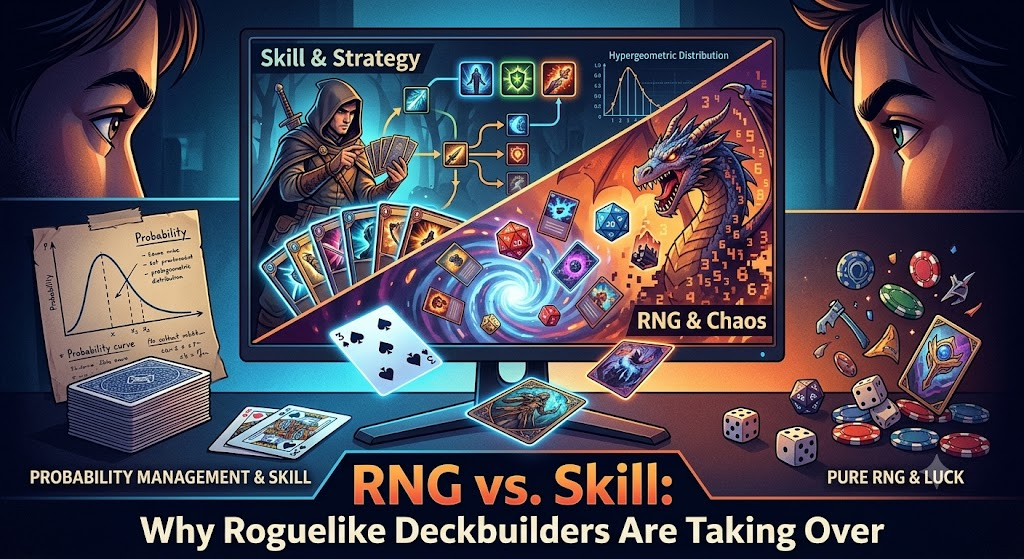
Think of the hypergeometric distribution as aggressive card counting for digital loot. This ruthless formula calculates the exact likelihood of pulling your most vital cards from the draw pile on turn one. Inexperienced players bloat their decks with superficially powerful attacks after every fight. High-level players act like ruthless accountants, spending precious gold at shops strictly to delete basic starter cards. Shrinking the deck size artificially forces the engine to spit out your required combo pieces right out of the gate. You aren’t just playing the cards. You are mathematically bullying the software.
The Invisible Pity Timer Keeping You Hooked
Here is the dirty little secret of the genre. True randomness is terrible for player retention. A perfectly fair coin can land on tails fifteen times in a row, but if a game denies a player a critical defensive relic for fifteen consecutive fights, they will uninstall the software immediately.
Developers know human psychology demands a narrative arc, not a raw bell curve. They build invisible safety nets using Pseudorandom Distribution (PRD) to lie to you just enough to keep you happy. Competitive games like League of Legends use this to smooth out critical hit chances. A stated 25% chance might actually start at 8.5% internally, increasing by a fixed increment every time it fails to trigger. This physically prevents devastating unlucky droughts.
Roguelike deckbuilders rely heavily on these hidden pity timers. Slay the Spire famously manipulates its potion drop rates in the background. The baseline chance for a consumable might sit around 40%. Fail to get one, and the software quietly bumps that percentage up by 10% for the next encounter. Get lucky, and the game drops the subsequent odds to throttle your momentum. Card reward screens operate under similar constraints. The chance of seeing a rare card starts in the negative integers and climbs incrementally with every common piece of garbage the game offers you. The software will not let you suffer a statistically possible dry spell. You think you are a strategic genius battling an unforgiving universe. The catch? The dealer is stacking the deck in your favor while pretending to look the other way.
The $92 Million Excel Spreadsheet
This carefully curated illusion of mastery translates directly into bulletproof economics. The development overhead for a deckbuilder is microscopic compared to open-world asset mills. The complexity lives entirely in the interaction of text boxes, user interfaces, and integers.
When Slay the Spire 2 raked in an estimated $92 million during its opening Early Access weeks, the industry effectively woke up to a new financial ceiling. The barrier to entry for heavy strategy has completely shattered. We are seeing 2026 releases like Talystro abandon the concept of health bars entirely. Instead, enemies exist as absolute integer values. A player must utilize their drawn cards and slotted dice to generate an attack that equals that exact number. An attack of 12 does absolutely nothing to an enemy valued at 11. It is a brutal, granular calculus exam that forces players to tune their output like a precise radio frequency.
Meanwhile, the mobile ecosystem is actively restructuring around this math-heavy format. The days of frantic, time-sliced clash arenas dominating app stores are fading. Deep macro-customization formats are taking their place. Breach Wanderers now allows mobile players to completely rig the procedural generation pool before a run even starts, giving them explicit control over the population size of the hypergeometric formula. Gamers have made their choice with their wallets. They do not want better graphics, and they certainly reject safe, committee-designed mechanics. Today’s audience craves a rigorous mathematical sandbox where outsmarting the system feels entirely earned. Players just want to construct ridiculous engines and watch the damaged integers go to the moon. Any studio ignoring this shift has already folded.


