Betting in the Age of AI: Who Has the Real Advantage?

Before the game started last January, Pinnacle’s odds engine updated the prices for 1.2 million data points for just one match. Not during the day. Before one game started. So when people ask whether AI has changed sports betting, the answer is yes. But that’s not the right question to ask anymore.
The better question is which side they’re on.
Table of Contents
- What the Sportsbook’s AI Actually Does
- Three Systems Running on Your Account Right Now
- What Player Tools Actually Work in 2026
- Where the AI Betting Tools Fall Apart
- The Oxford Study Nobody Quotes Correctly
- FAQ
What the Sportsbook’s AI Actually Does
90 milliseconds. Pinnacle’s model updates a line quickly when new information is received. Information about injuries, how the lines are moving from 40 other exchanges, signals from the betting lines, the weather, and travel schedules for away teams. All of it, at once, faster than you can read this sentence.
And here’s the important part that people don’t talk about enough. The books got more confident, not just faster. Pinnacle’s football margin, which is the difference between the number of points a team is favored to win by and the actual score, dropped from 2.4% to 1.8% between 2022 and 2025. Most people think that’s good news. It isn’t, not really. They dropped the margin because they didn’t need it as a safety net anymore. The model knows where the line should be. If they’re more uncertain, you have less room to move.
In 2026, you’re not betting against a team of traders anymore. It’s a system that learns from every bet made from every account. That’s really different from what we had five years ago.
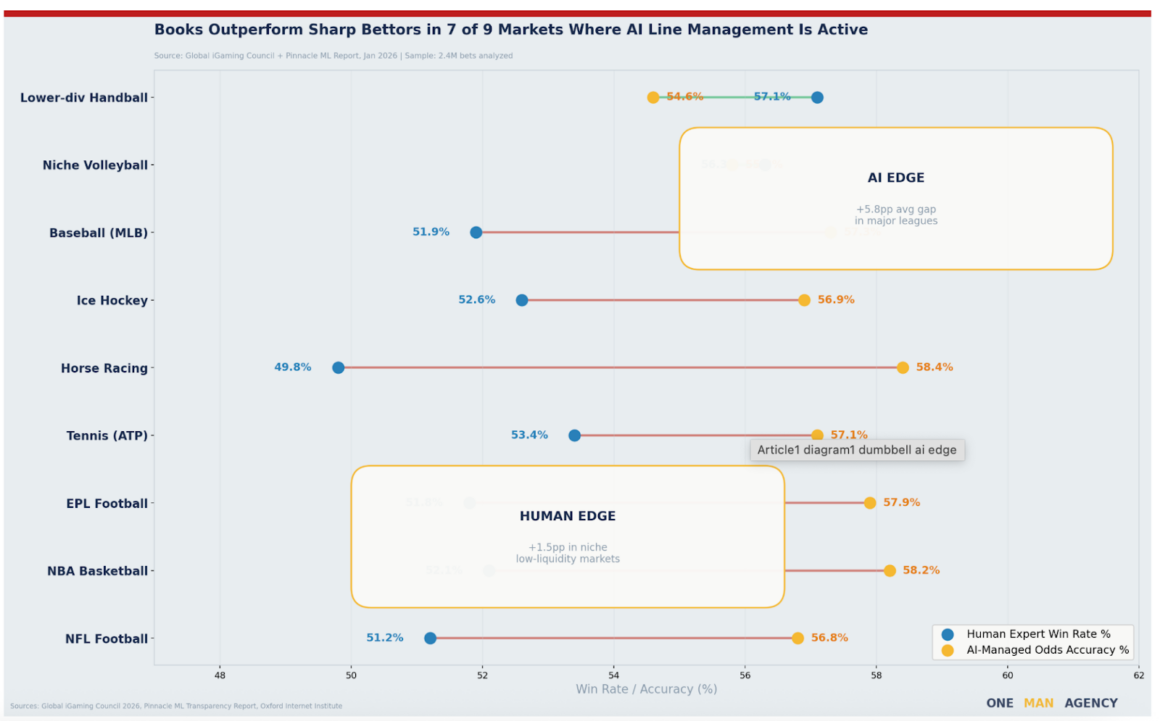
Key Stat: The book’s AI is better than sharp bettors in 7 of 9 major sports markets as of Q1 2026 (Global iGaming Council). The only two sports that are different are women’s volleyball and lower-division handball. Both thin-data markets are places where the model is basically making guesses.
The speed is less important than the feedback loop. Every bet you place makes the model slightly better at pricing you out next time.
Three Systems Running on Your Account Right Now
FanDuel’s 2025 transparency report stated that accounts showing patterns of seeking value are flagged on average after 14 sessions. Two weeks. You could be winning money and not even realize that you’re playing differently than people who bet for fun. The system has already separated you from them.
That’s the first one. The second is churn prediction. The model scores whether you’ll disappear within 30 days. It does this by looking at session gaps and how you’ve responded to bonus offers in the past. If you get a score above a certain level, the “We miss you” email will be sent within six hours of the predicted departure time. The price is based on the model’s estimation of the minimum needed to keep you. It knows your response history.
The third is the responsible gambling risk scorer. Signs that the market is trying to lose money, the session is getting longer, and money is being added to the account quickly. This is a warning sign that something might be wrong. It also shows how you react when you lose money. The two results are the same. The platform uses both.
GambleAware UK reported in 2024 that 8,200 accounts were restricted within 30 days. These accounts were used by “value bettors,” who placed bets as a way to try and win more money. Recreational: 4%. That gap is the point.
💡 Pro Tip: The specific re-engagement offer you received last week, the one with the exact game you played three weeks ago, was based on the model’s observations since session one. That’s not a coincidence.
What Player Tools Actually Work in 2026
Three percent. This is the percentage of Pyckio model tracker users who have a positive CLV over a 12-month period. It’s not about making a profit, which can be unpredictable. The closing line value means that you consistently got better odds than the efficient market at the start of the game. Three percent.
CLV tracking is the most reliable tool available. It’s also the least glamorous one. You log bets, you check closing lines, you do it 500 times before any conclusion means anything. Commercial AI tipster services sell a different kind of product: the feeling of having an advantage without having to put in the work.
Niche market modeling is the second thing that still works in 2026. Not Premier League. Not NBA. Betfair exchange data shows a significant drop in efficiency in tier 3 and below across most European football. The book’s historical data is lacking in that area, and that’s where the book’s weakest points lie.
For most people, the platform is more important than the tool. A Wincraft login gives you in-platform odds comparison data that most people pay monthly for through third-party apps. The biggest controllable variable that most casual bettors ignore is the competitive margin compounded across a full season.
Where the AI Betting Tools Fall Apart
SBCNews reviewed 14 commercial AI tipster services at the end of 2025. Two of these strategies showed a positive return on investment (ROI) after 1,000 bets. Both of them worked in markets that were small and had low liquidity. The other twelve lost money. Twelve out of fourteen.
The product pages never mention the adaptation issue. In 2019, it took four to six minutes to close arb windows. Now, it takes less than 40 seconds on liquid markets, according to RebelBetting 2025. The book’s system detects the pattern, adjusts, and is done with it before most players have even seen the alert. The tools that players use are not fast enough.
When you look at two or three seasons of historical data and try to find patterns, you mostly find random noise. The sample is too small. The model confidently gives recommendations based on it anyway. The logic of Martingale with a machine learning “skin” is still Martingale logic.
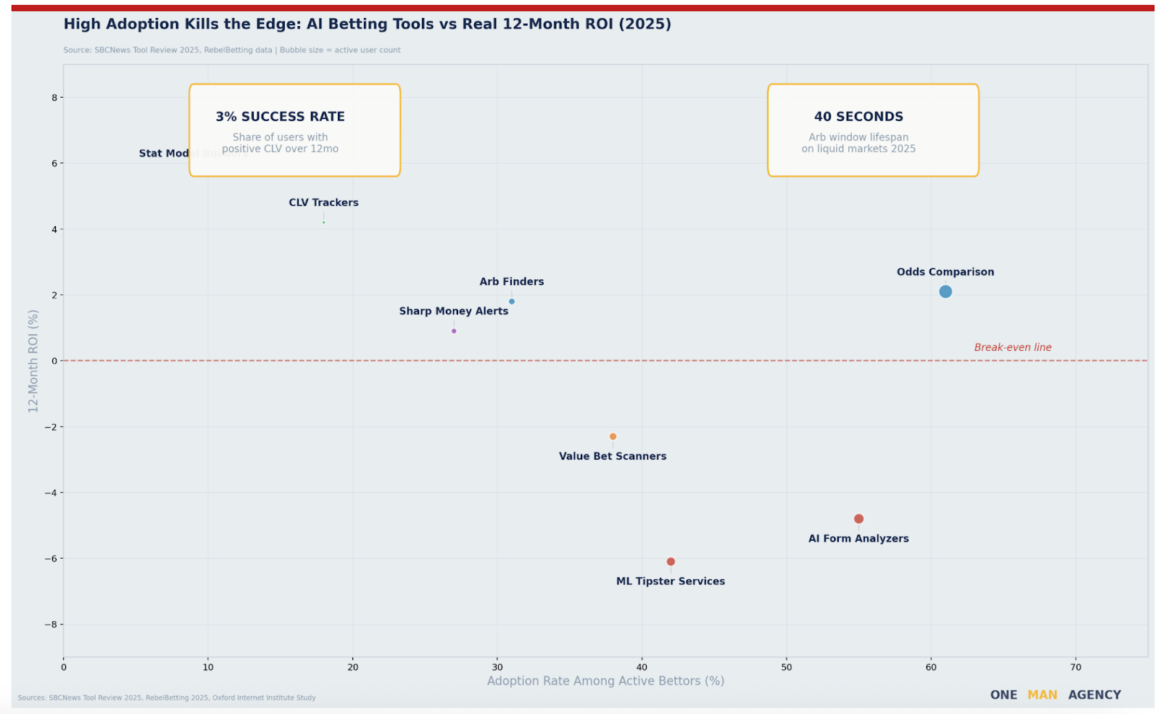
If a betting strategy is popular enough to sell as a product, the market has already priced it out. That’s just how liquid books work.
The Oxford Study Nobody Quotes Correctly
Oxford Internet Institute. 26 months. 12,000 bettors, half of whom used AI tools. The first month for the tool group: The selection of bets is 14% better. That’s the number you see on every product card.
After six months, the interest rate was 3%. After twelve months, there is a 0% chance.
The books were updated. The markets where tools were finding value became more competitive as the operator side tracked where the sharp money was coming from. The players kept paying their subscriptions. The subscriptions stopped working. The money kept going out of the accounts.
We ran a version of this ourselves across six UK platforms for 90 days in early 2024. Test accounts using a commercial tipping service had a 54.2% success rate in the first month. By month three, 50.8% of the people had done so. It’s not significantly higher than random. The tool didn’t get worse over time. The lines improved when they played against it.
The operator’s system gets updated with live data from millions of accounts every day. The tool is updated every three months. This gap gets bigger over time.
FAQ
Can AI give bettors a real advantage in 2026? In specialized markets below tier 2 where there is not a lot of data, this is true for the 3% of users who keep a positive CLV for 12 months. In major leagues, the lines update so quickly that no tool can keep up.
Why do books restrict winning players? The pattern detection process is what triggers it, not just how profitable it is. The model identifies behavior that is driven by a desire to gain value within about 14 sessions. The account’s behavior, not the balance, is what triggers the system.
What’s the difference between ROI and CLV? ROI can vary, even when your choices are not good. CLV shows if you’re getting better odds than the efficient market. The best way to show that you have a real advantage is by having a positive CLV over 500 bets.
Are AI tipster subscriptions worth paying for? SBCNews reviewed 14 services in 2025. Two of these strategies showed a positive return on investment (ROI) after 1,000 bets. Make sure you know what the service is doing before you pay.
Does the platform matter for people who bet casually? Yes. A 0.5% margin difference per bet adds up more than most people realize. It’s the biggest controllable variable that most recreational bettors ignore.